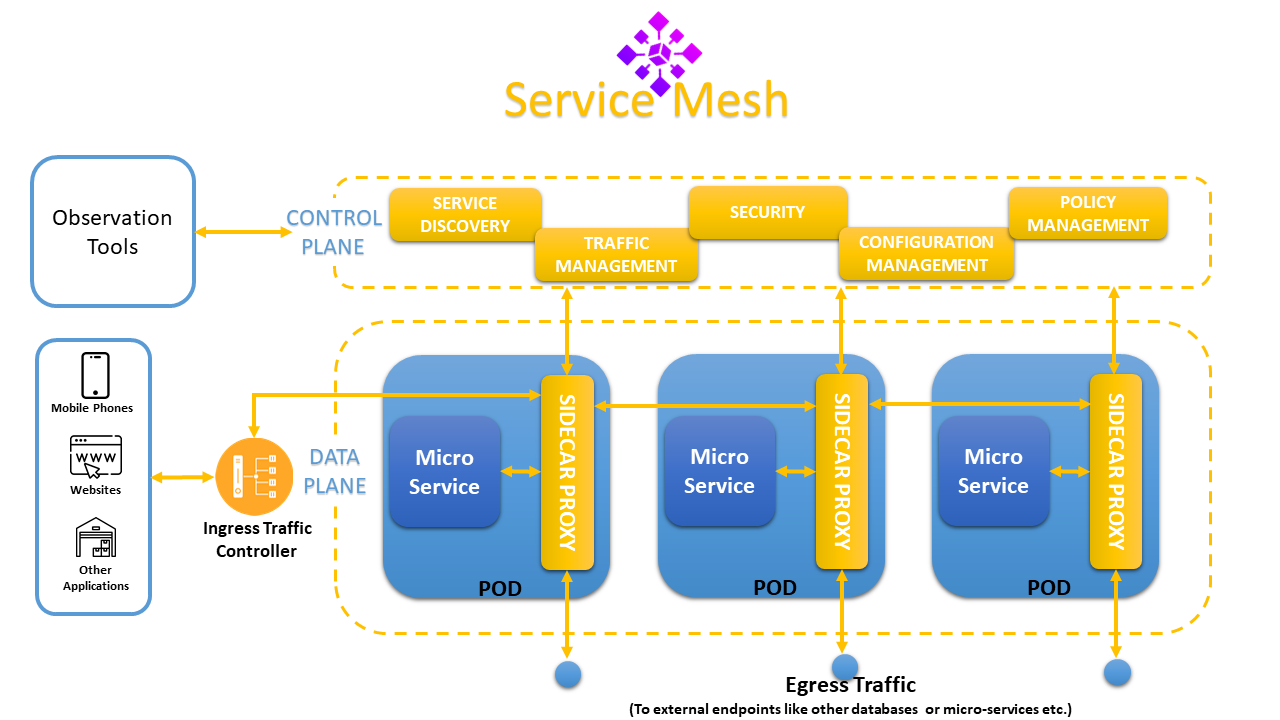
Service Mesh - Managing Microservices Communication
Service Mesh is a software infrastructure layer that manages communication between services in microservices systems, providing load balancing, security, observability, traffic control, and fault handling without changing application code.
Introduction
Service Mesh is a software infrastructure layer that manages communication between services in microservices systems. It provides load balancing, security, observability, traffic control, and fault handling, enabling services to communicate efficiently without changing application code.
Popular Service Mesh tools include Istio, Linkerd, and Consul.
Benefits of Service Mesh
Automatic service-to-service communication management - No application code changes required. Enhanced security - TLS encryption, service authentication, RBAC policies. Performance optimization - Smart load balancing and traffic control. Comprehensive observability - Logs, metrics, and tracing for monitoring. High resilience - Automatic fault detection and recovery.
Popular Service Mesh Tools
Istio - The most powerful solution
Istio is an open-source Service Mesh platform that provides control, security, and observability for Kubernetes services.
Key features:
- mTLS support for secure service communication.
- Smart load balancing, retries, and timeouts.
- API gateway management and access policies.
Istio Gateway example:
| |
Linkerd - Lightweight and fast
Linkerd is a lightweight Service Mesh optimized for Kubernetes, designed to reduce latency and resource usage.
Key features:
- Automatic TLS (mTLS) for all communications.
- Built-in tracing and metrics.
- Quick installation with a single CLI command.
Linkerd configuration example:
| |
Consul - Service Mesh with service discovery
Consul is not only a Service Mesh, but also provides service discovery, configuration management, and secure communication between services.
Key features:
- Service discovery for Kubernetes and traditional systems.
- Integration with Envoy Proxy for traffic management.
- Supports multi-cluster and hybrid cloud environments.
Consul service registration example:
| |
Service Mesh Comparison
| Feature | Istio | Linkerd | Consul |
|---|---|---|---|
| Visual UI | Yes | No | Yes |
| mTLS support | Yes | Yes | Yes |
| High performance | Needs tuning | Fast | Moderate |
| Service discovery | No | No | Yes |
Conclusion
Service Mesh simplifies managing communication between microservices, ensuring security, observability, and high performance.
If you need the most powerful solution, try Istio. If you prioritize performance and ease of setup, choose Linkerd. If you need service discovery and multi-cloud, consider Consul.
References: Istio documentation Linkerd documentation Consul documentation
Have you tried any Service Mesh deployments? Share your experience!
Final step: Learn about Cloud Design Patterns - a set of proven patterns for building efficient, flexible, and scalable cloud applications. They address common challenges like high availability, fault tolerance, elastic scaling, and security in cloud environments.