Introduction
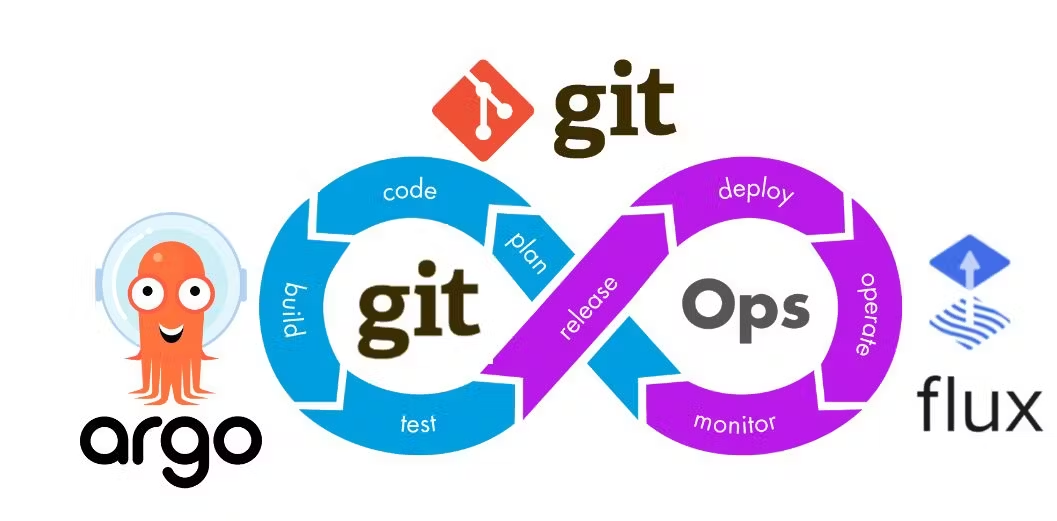
GitOps is a method for managing infrastructure and application deployments by using Git as the single source of truth. It automates deployments, ensures consistency, and improves change tracking.
GitOps extends DevOps practices by applying version control and CI/CD principles to infrastructure management. Instead of manual changes, every update flows through pull requests and is automatically synchronized with live environments.
🚀 Benefits of GitOps
✅ Version control: Every change is tracked in Git, making it easy to audit or roll back when needed.
✅ Automated deployments: Tools like ArgoCD or FluxCD sync environments automatically.
✅ Improved security: All changes go through Git, preventing direct access to production systems.
✅ High resilience: Systems can recover quickly by re-applying Git state after incidents.
✅ Better team collaboration: Changes are reviewed via pull requests, enabling smoother teamwork.
🛠️ Popular GitOps Tools
ArgoCD - Powerful continuous deployment
ArgoCD is a continuous deployment (CD) tool for Kubernetes. It automates deployments by watching application state in Git and syncing it with the live cluster.
🔹 Key features:
- Automatic sync between Git and environment state.
- Visual web UI for deployment status.
- Supports Helm, Kustomize, and other configuration tools.
🔹 Example ArgoCD application
| |
FluxCD - Automated deployment management
FluxCD is a GitOps tool that deploys applications to Kubernetes by watching Git repositories and updating clusters automatically.
🔹 Key features:
- Tracks Git repositories and deploys automatically.
- Supports Helm, Kustomize, and many CI/CD systems.
- Provides automatic container image updates.
🔹 Example FluxCD configuration:
| |
🔥 ArgoCD vs FluxCD
| Feature | ArgoCD | FluxCD |
|---|---|---|
| Visual UI | ✅ Yes | ❌ No |
| Helm support | ✅ Yes | ✅ Yes |
| Automatic container image updates | ❌ No | ✅ Yes |
| Canary/Rollback deployments | ✅ Yes | ✅ Yes |
📌 Conclusion
GitOps simplifies application deployments by using Git as the central control layer. With tools like ArgoCD and FluxCD, teams can automate deployments, ensure consistency, and improve system resiliency.
🔗 References:
Have you tried GitOps in your projects? Share your experience! 🚀
👉 Next step: Learn about Service Mesh - a software infrastructure layer that manages communication between services in microservices systems. It provides load balancing, security, observability, traffic control, and fault handling so services can communicate efficiently without changing application code.