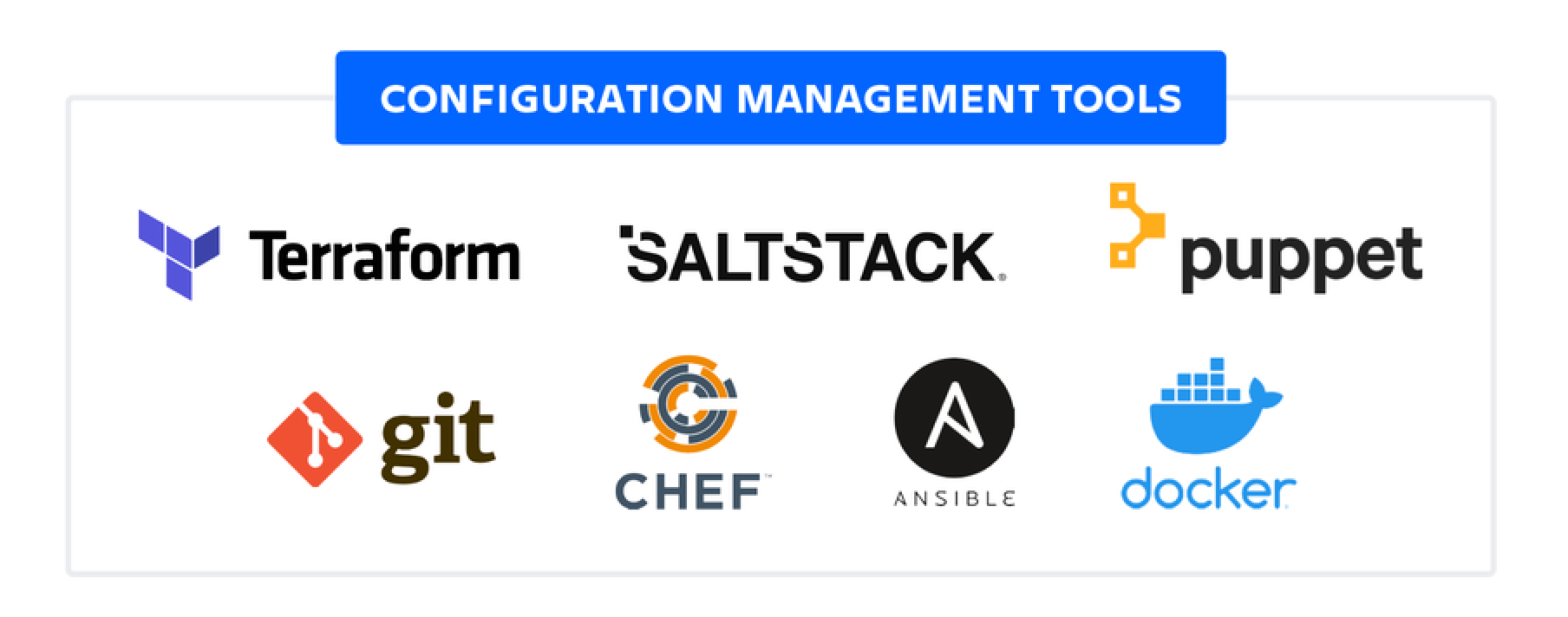
🔧 Configuration Management
Configuration management is the process of managing and maintaining consistency of components within an information technology system. In the software field, it includes monitoring, tracking, and managing system configuration changes throughout the product lifecycle. Applying configuration management helps increase synchronization, reduce error risks, and ensure compliance with standards in CI/CD (Continuous Integration and Continuous Deployment) processes.
🌐 Popular Configuration Management Tools
🚀 Ansible
Ansible is an open automation tool, primarily used for configuration management, application deployment, and task automation.
🔄 Features:
- Uses YAML (playbooks) to define desired states.
- Works without requiring agent installation.
- Suitable for small to large scale environments.
💡 Ansible usage example:
| |
📖 Useful free resources:
🌟 Chef
Chef (now part of Progress Chef) is one of the first configuration management tools. It uses Ruby language and emphasizes idempotence (ensuring running n times produces the same result).
🔄 Features:
- Client/server based.
- Has Chef-Solo for standalone deployment.
- Suitable for enterprise environments.
💡 Chef usage example:
| |
📖 Useful free resources:
🏰 Puppet
Puppet is a declarative configuration management tool that operates in a client/server model and supports multiple operating systems.
🔄 Features:
- Large scale management.
- Periodic configuration checking and application.
- Integration with many DevOps tools.
💡 Puppet usage example:
| |
📖 Useful free resources:
🎉 Conclusion
Configuration management is an important element in the DevOps process, helping ensure consistent system operation, minimize errors, and enhance reliability. Depending on needs and scale, businesses can choose Ansible, Chef, or Puppet to manage infrastructure effectively.
👉 Next step: Learn about Continuous Integration and Continuous Deployment (CI/CD), which is an automation process in software development that helps integrate, test, and deploy applications continuously.