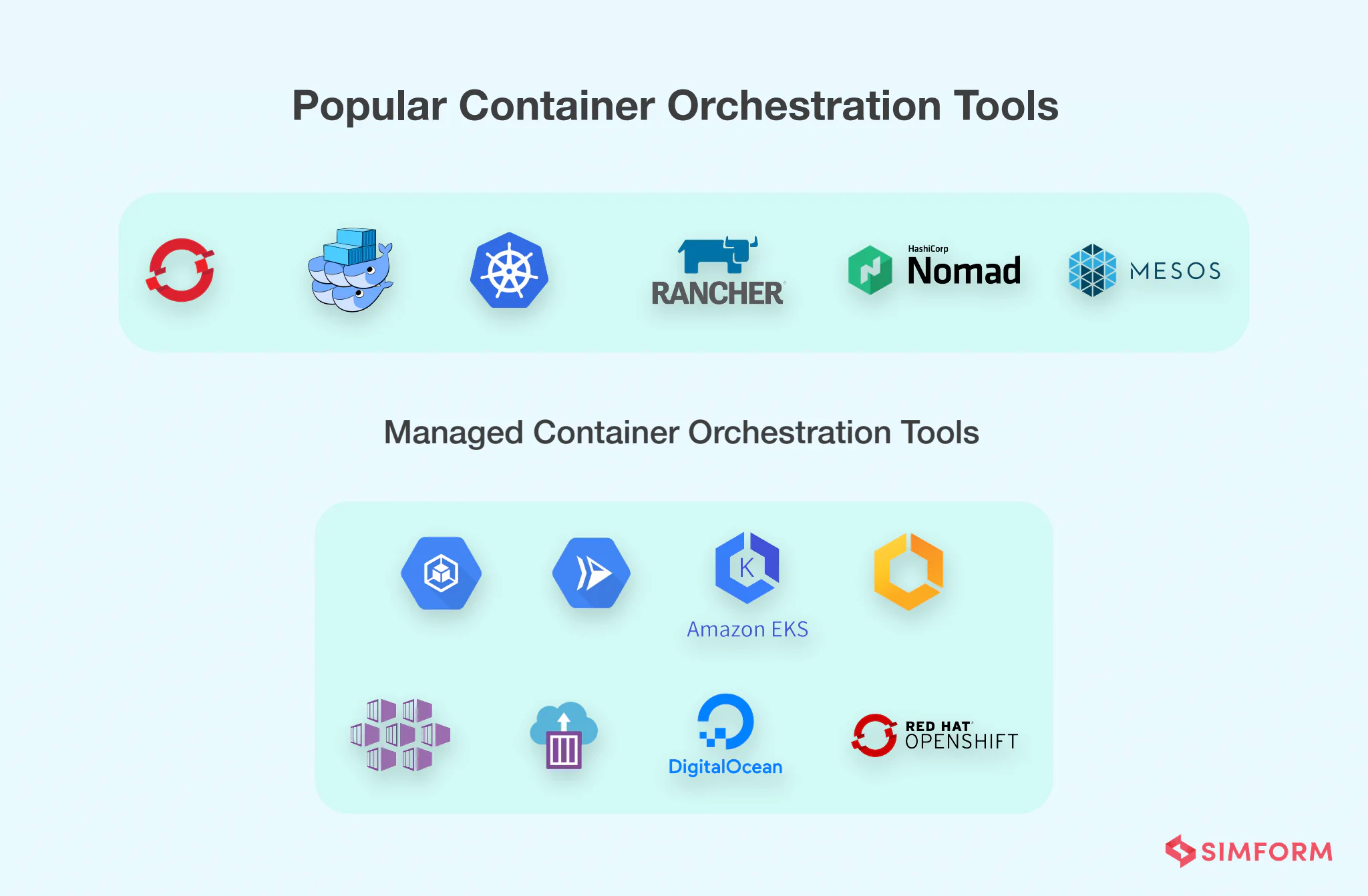
🔍 What is Container Orchestration?
Container orchestration is the process of managing and automating the container lifecycle, including deployment, scaling, and networking across multiple servers. It is critical for running complex applications in production environments.
By using tools like Kubernetes, Docker Swarm, and Apache Mesos, organizations can ensure high availability, scalability, and reliability for their applications. Container orchestration automates operational tasks and provides a strong foundation for microservices, cloud-native development, and DevOps.
📚 Free resources:
☸️ Kubernetes
Kubernetes is the most popular open-source platform for container management. It allows container deployment across multiple servers, defining availability, deployment logic, and scaling through YAML.
Kubernetes originated from Borg, Google’s internal platform, and has become a critical skill for DevOps engineers. Many organizations now have Platform Engineering teams dedicated to supporting Kubernetes for product teams.
📚 Free resources:
- 🗺️ In-depth Kubernetes roadmap
- 🌐 Official Kubernetes website
- 📖 Kubernetes overview
- 🎥 Complete Kubernetes course - beginner to advanced
📌 Example:
| |
☁️ GKE / EKS / AKS
🔹 GKE - Google Kubernetes Engine
Google Kubernetes Engine (GKE) is a managed Kubernetes service by Google Cloud. It helps deploy, manage, and scale container applications with Kubernetes without managing the cluster manually.
🔹 EKS - Amazon Elastic Kubernetes Service
Amazon Elastic Kubernetes Service (EKS) is a Kubernetes service provided by AWS. It automatically manages the Kubernetes control plane and integrates with other AWS services.
🔹 AKS - Azure Kubernetes Service
Azure Kubernetes Service (AKS) is Microsoft Azure’s Kubernetes service. AKS supports monitoring, security, autoscaling, and integration with Azure DevOps.
📚 Free resources:
- ☁️ Google Kubernetes Engine (GKE)
- 🟧 Amazon Elastic Kubernetes Service (EKS)
- 🔵 Azure Kubernetes Service (AKS)
- 🎥 AWS EKS tutorial
- 🎥 What is Google Kubernetes Engine?
🚀 ECS / Fargate
ECS is a container management service that runs on AWS EC2, giving you control over the server infrastructure.
Fargate is a serverless container service that runs containers without managing servers or clusters.
📚 Free resources:
📌 Example:
| |
🐳 Docker Swarm
Docker Swarm is a cluster of Docker nodes (physical or virtual machines). The cluster is managed by a swarm manager, and the participating machines are nodes.
📚 Free resources:
- 📄 Docker Swarm documentation
- 🔧 Manage Docker Swarm with Portainer
- 📦 Docker Swarm with GlusterFS storage
- 🎥 Docker Swarm introduction | step-by-step
📌 Example:
| |
✅ Conclusion
Container orchestration plays a vital role in managing containerized applications, helping simplify operations, optimize resources, and improve availability. Tools such as Kubernetes, Docker Swarm, ECS, and Fargate offer flexible solutions for modern enterprises. Choosing the right tool enables organizations to maximize the power of containerization and cloud computing. 🚀
👉 Next step: Learn about Application Monitoring - tracking, measuring, and analyzing application performance, status, and behavior to detect incidents, optimize performance, and ensure a great user experience. Popular tools include Prometheus, Grafana, Datadog, and New Relic for collecting data from applications, servers, and infrastructure to provide alerts and detailed reports.